About Researcher
Tianhua Ju is a researcher in materials science, specializing in computational thermodynamics and modeling, with a particular focus on alloy melt thermodynamics. His research foundation was established under the mentorship of Prof. Xueyong Ding (丁学勇) at Northeastern University. Currently based in Nanning, Guangxi, his work centers on the development of advanced thermodynamic models, thermodynamic strategies for impurity control in secondary aluminum, and the design of novel energy storage materials.
Research Highlights
- Unified Extrapolation Model (UEM): Established the Unified Extrapolation Model (UEM) framework, utilizing contribution coefficients to unify traditional geometric models (Kohler, Muggianu, Toop, etc.).
- UEM-Miedema Framework: Developed the UEM-Miedema framework to accurately calculate solute activity interaction parameters in dilute alloy melts.
- Thermodynamic Software: Created a computational suite based on these models to predict critical metallurgical phenomena, such as solidification temperatures and inclusion precipitation behavior in alloy melts.
Mathematical Framework
The Unified Extrapolation Model (UEM) generalizes classical geometric extrapolation models (Kohler, Muggianu, Toop) by replacing their fixed, composition-independent weighting with a data-driven contribution coefficient \(\alpha\). For a multicomponent solution, the excess Gibbs energy is assembled from its constituent binary sub-systems:
\[ \Delta G^{E} = \frac{x_i x_j}{X_{ij}^{i} X_{ij}^{j}} \Delta G^{E}_{ij}\!\left(X_{ij}^{i}\right) + \frac{x_i x_k}{X_{ik}^{i} X_{ik}^{k}} \Delta G^{E}_{ik}\!\left(X_{ik}^{i}\right) + \frac{x_j x_k}{X_{jk}^{j} X_{jk}^{k}} \Delta G^{E}_{jk}\!\left(X_{jk}^{j}\right) + \cdots \]
where each pseudo-binary composition \(X_{ij}^{i}\) reshapes the real mole fraction \(x_i\) to account for every other component \(k\) present in the system:
\[ X_{ij}^{i} = \frac{\delta_{ij}^{i}}{\delta_{ij}^{i} + \delta_{ij}^{j}}, \qquad X_{ij}^{j} = \frac{\delta_{ij}^{j}}{\delta_{ij}^{i} + \delta_{ij}^{j}} \]
\[ \delta_{ij}^{i} = x_i + \sum_{k \neq i,j}^{n} \alpha^{k}_{i(ij)}\, x_k, \qquad \delta_{ij}^{j} = x_j + \sum_{k \neq i,j}^{n} \alpha^{k}_{j(ij)}\, x_k \]
The contribution coefficient \(\alpha^{k}_{i(ij)}\) — how strongly component \(k\) is redistributed toward \(i\) rather than \(j\) — is itself defined from the thermodynamic dissimilarity between the i–k and j–k binary sub-systems:
\[ \alpha^{k}_{i(ij)} = \frac{d_{k-j}}{d_{k-j} + d_{k-i}}\, \exp(-d_{k-i}), \qquad d_{k-i} = \left| \chi_k^{\,i} - \chi_i^{\,k} \right| \]
with the property difference \(\chi\) taken from the infinite-dilution limit of the binary excess Gibbs energy:
\[ \chi_k^{\,i} = \frac{1}{RT} \lim_{x_i \to 0} \frac{\partial \Delta G^{E}_{ik}}{\partial x_i} \]
Classical geometric models emerge as special, composition-independent limits of \(\alpha\) — Kohler (\(\alpha \equiv 0\)), Muggianu (\(\alpha \equiv 0.5\)), Toop (\(\alpha \in \{0,1\}\), asymmetric) — while UEM instead lets \(\alpha\) respond continuously to the underlying thermodynamic data. Coupling this framework with the Miedema macroscopic-atom model for the underlying binary sub-system properties gives the UEM–Miedema framework used throughout this work to predict solute activity interaction coefficients in dilute alloy melts.
Model Performance
Below are comparative results demonstrating the accuracy of the UEM framework against traditional geometric models.
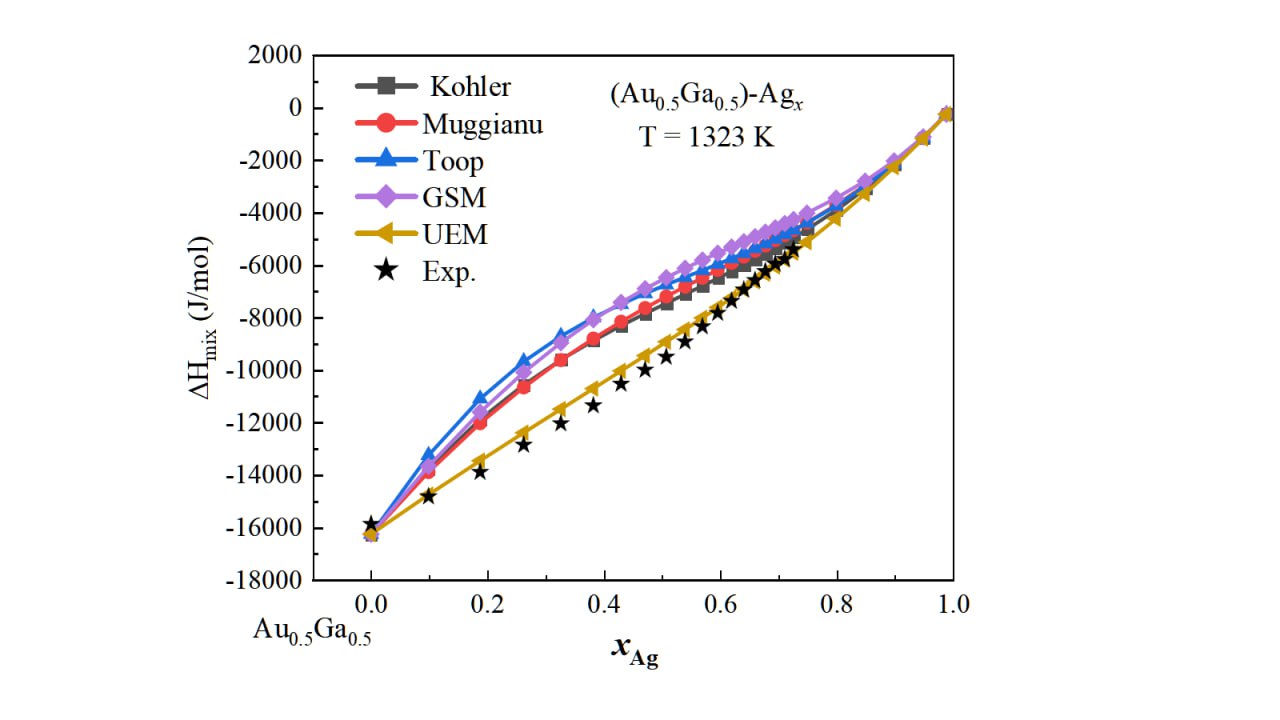
Figure 1: Performance comparison in the Au-Ga-Ag ternary system.
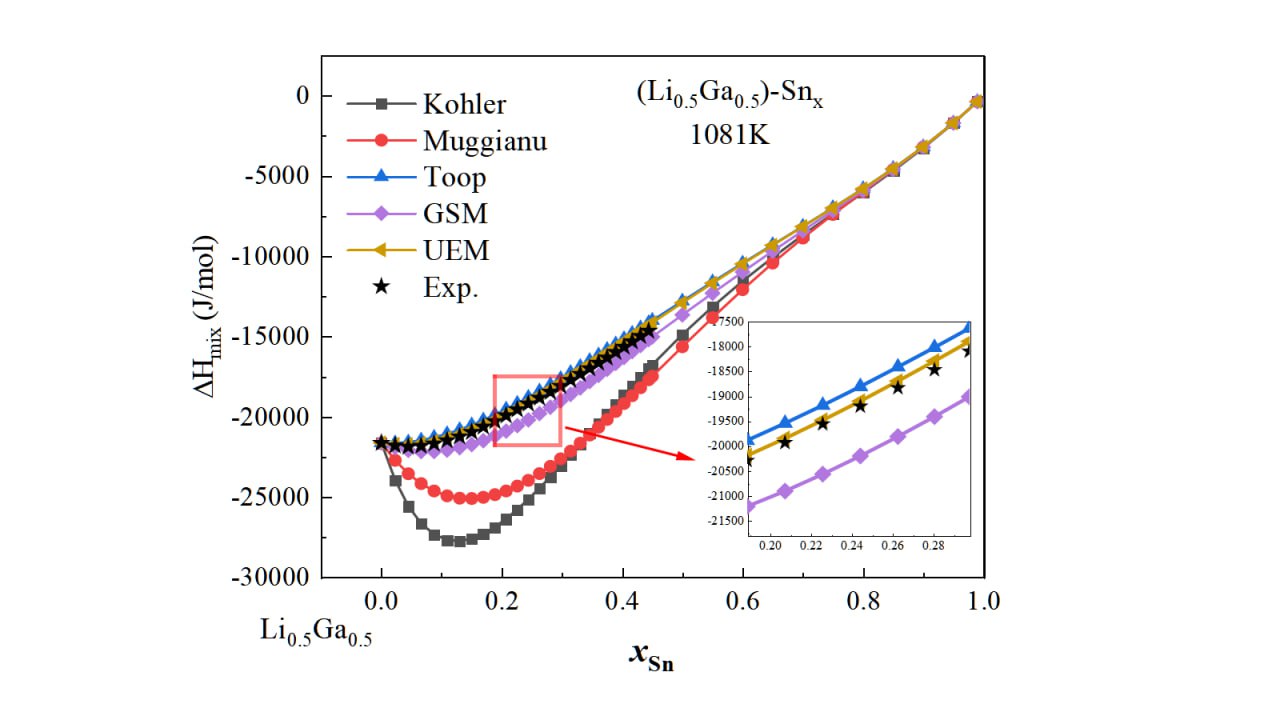
Figure 2: Performance comparison in the Li-Ga-Sn ternary system.
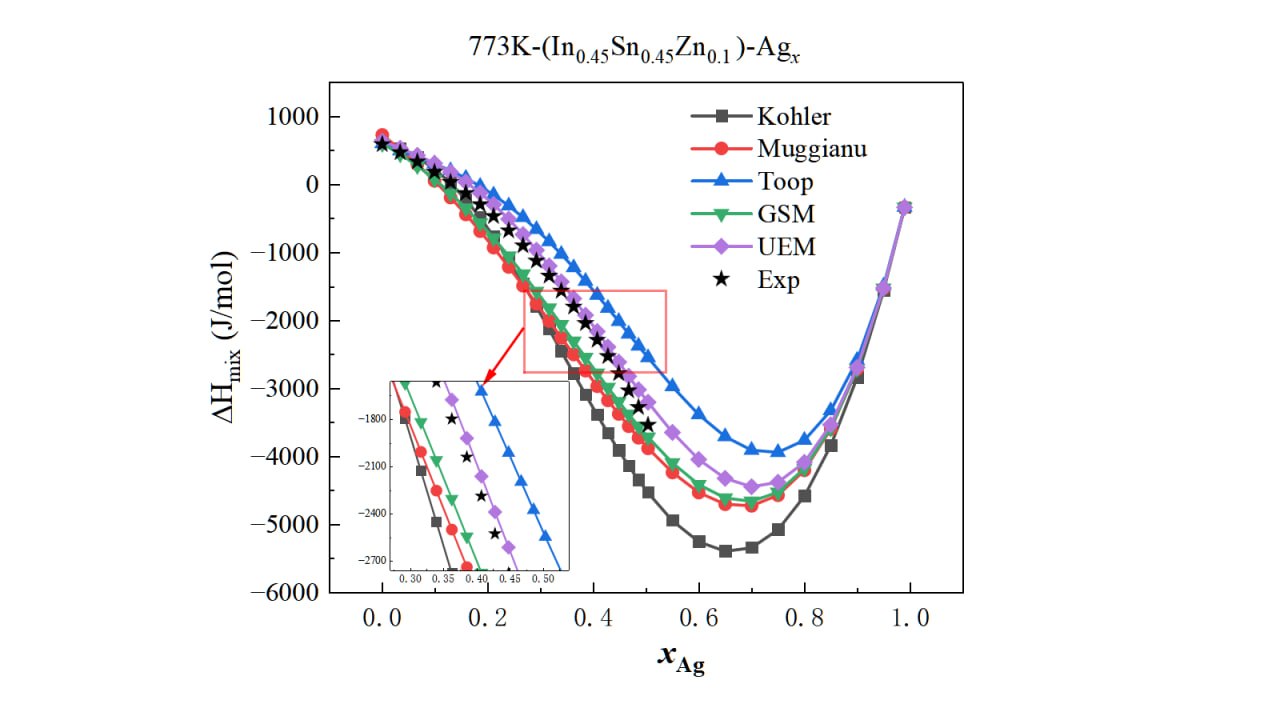
Figure 3: Performance comparison in the In-Sn-Zn-Ag quaternary system.
Software & Mobile App
The UEM and UEM–Miedema models described above are implemented in AlloyAct Mobile, an Android app for calculating activity interaction coefficients of solutes in alloy melts. The app is currently in closed beta testing on Google Play.
🧪 Seeking Android Beta Testers
Join the closed beta to try AlloyAct Mobile and help shape the release:
- Join the Google Group: alloyact-mobile-testers
- Opt in as a tester: play.google.com/apps/testing/com.alloyact.mobile
Selected Publications
- Tianhua Ju, Yun Tang, Yurui Li, Donglou Ren. Comparing two property difference formulations in the Unified Extrapolation Model for multicomponent solution thermodynamics. Thermochimica Acta, 2026.
- Qiwen Lv, Yurui Li, Zhuo Chen, Nian Shu, Cuiyun He, Wei He, Changzhong Liao, Tianhua Ju*. Calculation of solute activity interaction coefficients in Ni-based melts using UEM–Miedema framework model. Canadian Metallurgical Quarterly, 2025. (DOI: 10.1080/00084433.2025.2588500)
- Tianhua Ju, Zhenlin Huang, Xueyong Ding, Xinlin Yan, Changzong Liao. A Unified Extrapolation Thermodynamic Model for Multicomponent Solutions Based on Binary Data. Thermochimica Acta, 2024, 740: 179824.
- Tianhua Ju, Qiwen Lv, Yan Wu, Cuiyun He, Changzhong Liao, Han He. Influence of property difference definitions on activity interaction coefficients within the UEM-Miedema framework. Journal of Molecular Liquids, 2025, 128466.
- Tianhua Ju, Xueyong Ding, Long Zhang, Weiliang Chen, Bo Wang, Xinlin Yan. A General Model for Solutes Activity Interaction Parameters in Dilute Metallic Solutions. ISIJ International, 2020, 60(11): 2416-2424.
For a complete list of publications and citations, please visit Tianhua Ju's Google Scholar Profile.